
Behind the Photograph
Looking Beyond the Subject
The background is part of the story.
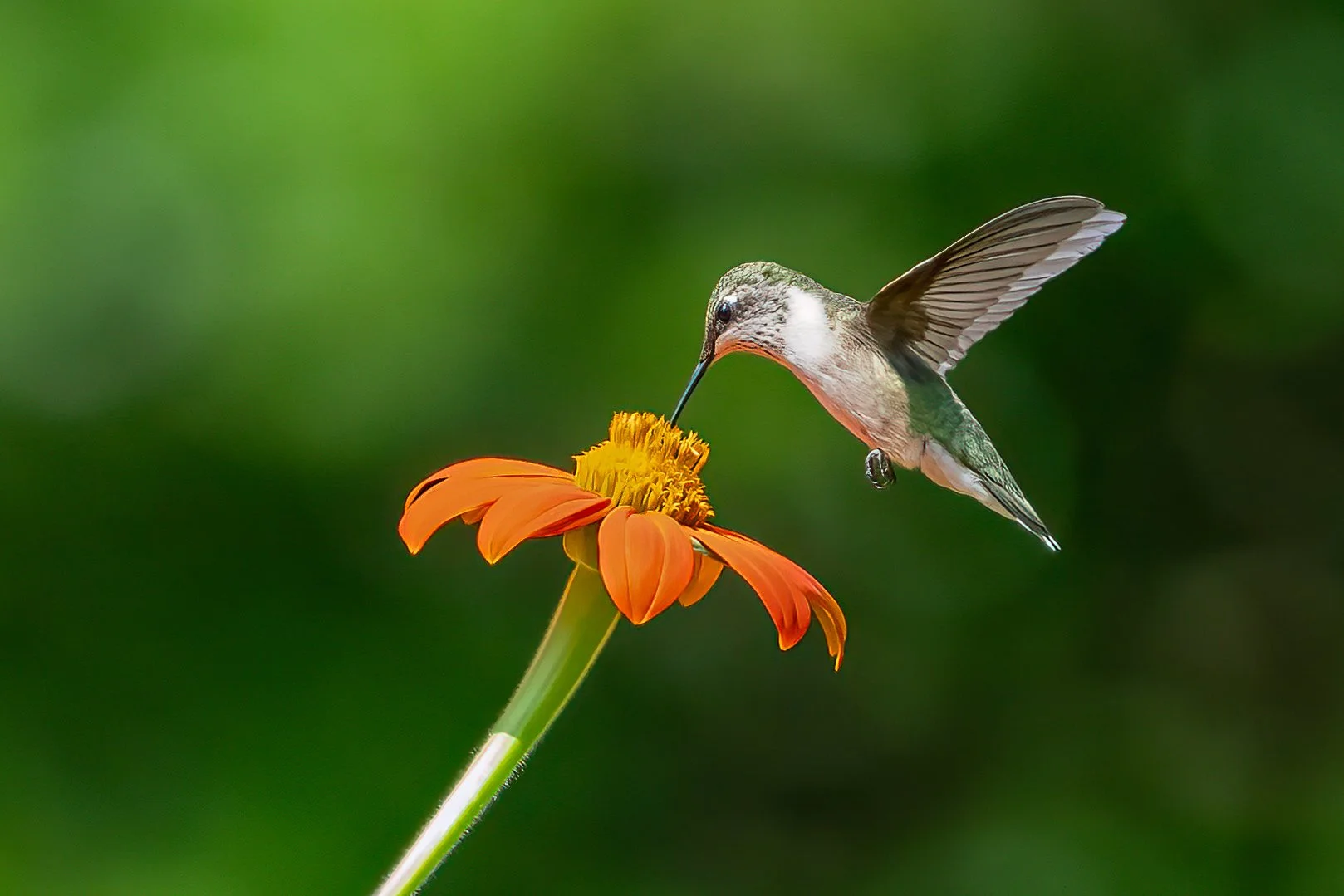
A ruby-throated hummingbird pauses briefly to feed from an orange Mexican sunflower, framed by a soft green background that keeps the viewer's attention where it belongs.
The Story
Hummingbirds are fascinating creatures. Watching their movements can be mesmerizing as they dart and zigzag through a garden with incredible speed and precision. When I first became interested in photographing them, I spent a great deal of time learning how to capture sharp images of birds that rarely stay still for more than a moment. Finding the right balance between aperture, shutter speed, and ISO was essential to creating photographs I was proud of.
After many attempts at photographing hummingbirds visiting the feeder in my backyard, I wanted something more natural. Rather than capturing birds at an artificial feeding station, I hoped to photograph them interacting with native wildflowers in their natural environment.
That search led me to a local wildflower preserve in Montgomery County, Pennsylvania, where hummingbirds are frequent visitors throughout the summer. Over time, it became one of my favorite places to observe and photograph these remarkable birds. It also taught me one of the most important lessons in wildlife photography: creating a compelling image often depends just as much on what surrounds the subject as the subject itself.
The Approach
Once I arrived at the wildflower preserve, I knew the hummingbirds would be active among the many native flowers throughout the garden. Rather than following a specific bird, I spent time observing their feeding patterns and looking for flowers that hummingbirds visited naturally. Experience had taught me that patience was just as important as camera settings.
When I found a patch of vibrant orange Mexican sunflowers that hummingbirds visited frequently, I resisted the urge to begin photographing immediately. Instead, I took time to study what was behind the flowers. From one position, the background was cluttered with branches and other vegetation that competed for attention. By slowly moving around the flower and changing my shooting angle, I found a viewpoint where the background became a smooth wash of green, allowing the hummingbird and flower to stand apart from everything else.
Knowing that hummingbirds pause for only a fraction of a second before darting to the next blossom, I pre-focused on the flower and waited. Eventually, one hummingbird hovered just long enough to create the moment I had envisioned. The clean background, combined with the bird's graceful pose and the vibrant orange flower, transformed what could have been an ordinary wildlife photograph into an image with a stronger sense of balance and simplicity.
That experience reinforced an important lesson for me. The hummingbird may have been the subject, but the background played an equally important role in the success of the photograph. Sometimes the difference between a good image and a memorable one isn't the subject at all—it's everything behind it.
In the Field
Camera: Sony a7 III
Lens: Tamron 150–500mm f/5-6.7 Di III VC VXD
Focal Length: 500mm
Aperture: f/6.7
Shutter Speed: 1/3200 sec
ISO: 6400
Field Note: I photographed this image using Auto ISO, with an upper limit of ISO 6400. This allowed me to prioritize the fast shutter speed needed to freeze the hummingbird's movement while letting the camera automatically adjust ISO as lighting conditions changed.
Post Processing
My goal in post-processing was to preserve the natural beauty of the scene while ensuring that the hummingbird remained the clear focal point. I began by processing the RAW file in Lightroom Classic, making subtle adjustments to exposure, contrast, color, and selective sharpening while maintaining the vibrant yet natural appearance of the bird and flower.
Because the image was captured using Auto ISO, which reached my preset maximum of ISO 6400, I also used Topaz Photo AI to reduce noise while preserving fine feather detail. The final adjustments were intentionally subtle, allowing the clean green background to remain soft and unobtrusive so the hummingbird and flower remained the unmistakable focal point.
What I Learned
One of the most valuable lessons I've learned is that a compelling photograph isn't created by the subject alone. Every element within the frame contributes to the final image, and the background is often just as important as the subject itself. Before pressing the shutter, I now make it a habit to look beyond the subject and ask whether the background supports the story or competes with it. More often than not, a small change in position is all it takes to transform a good photograph into a much stronger one.
Final Reflection
The hummingbird drew my attention. The background gave it a place to belong.
Every photograph has a story beyond what appears in the frame. Thank you for joining me Behind the Photograph. I hope these stories and lessons inspire you to see more thoughtfully, photograph more intentionally, and discover the moments waiting to be seen.

© 2026 John S Baker Photography
www.johnsbakerphotography.com